Part 1 of 8 · Mon 5 Oct 2026 · 3 min read
We asked people how they really track work. Here's what they said.
We surveyed 10 people who work with others about how they track tasks, find out where work stands, and use AI. Here's what they told us.
Most advice about task management describes how work should be tracked. We wanted to know how it actually is.
So in October we asked 10 people who work with at least two others to walk us through their real habits: which tools they open, how they find out where a task stands, what frustrates them, and how AI chat fits into their day. Half were team leads or managers, four were individual contributors, and one was a freelancer.
Ten people is a small group, so treat everything below as early signals rather than industry statistics. But the answers lined up in a few clear patterns.
1. People check their tools constantly, but still chase each other
Nine in ten open their task tool several times a day. Yet when they need to know how far along someone else's work is, half skip the board and message or call the person directly.
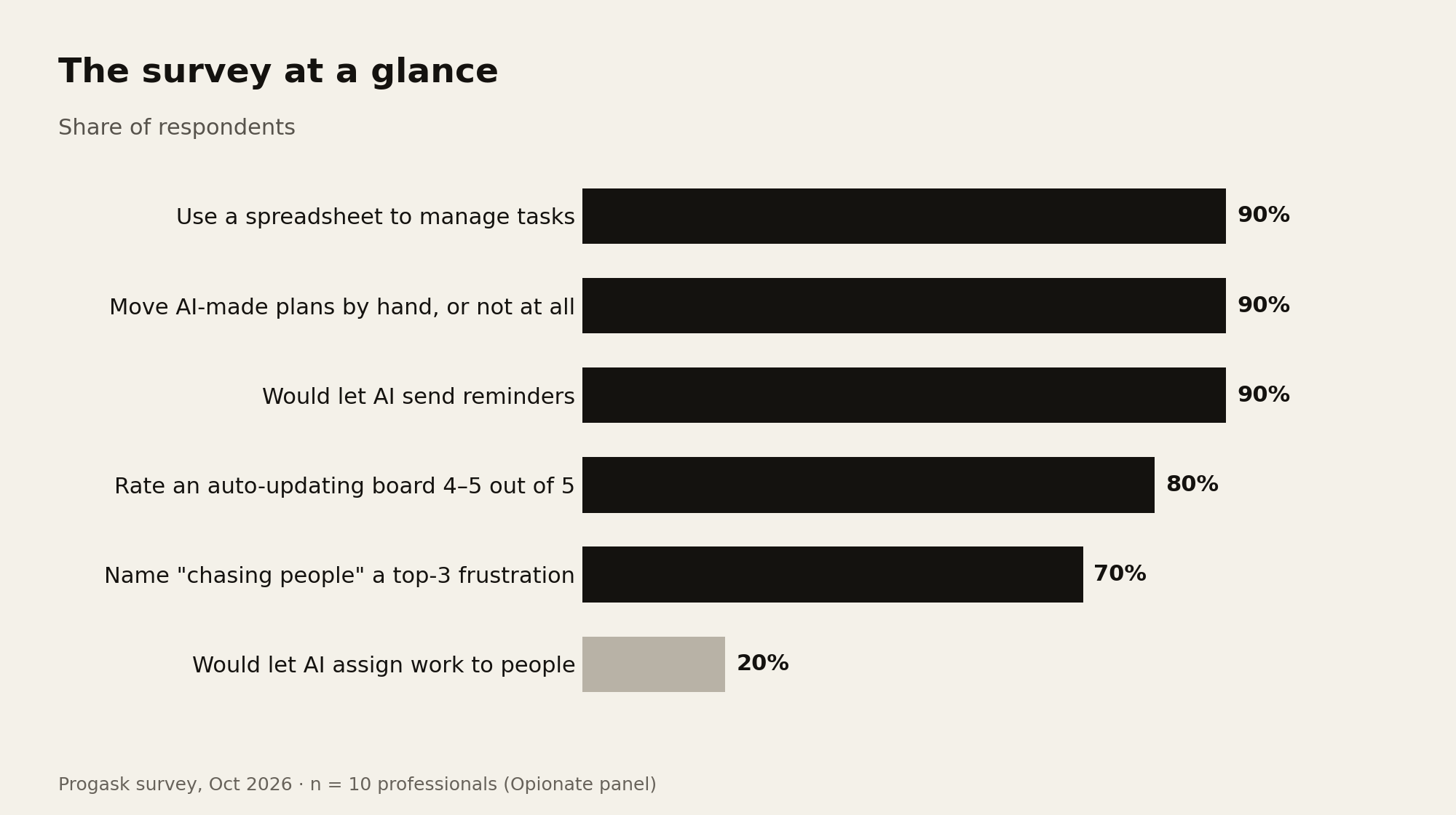
That habit shows up in their frustrations too. "Chasing people for status updates" was the most common pain: 70% put it in their top three. (More in post 2: The status-chasing tax.)
2. Boards feel accurate until something slips
Asked how well their board reflects reality, people were fairly generous: 3.9 out of 5 on average, and nobody rated it below 3.
Then we asked for the story of the last task that slipped. Of the eight people who described how they found out, seven learned about it at the deadline, after it, or only because someone asked. (More in post 3: Your board says it's fine. Your deadline disagrees.)
3. Everyone plans with AI. Almost nobody's plan reaches the board.
Every respondent uses an AI chat assistant like ChatGPT, Claude or Gemini at least weekly, and 60% use one daily. The most common task-related use is breaking work into steps (70%).
But when the chat produces a plan, 60% retype it into their task tool by hand, 20% leave it sitting in the chat, and 10% copy and paste it. Only one person had the plan flow across on its own. (More in post 4: Plans are made in AI chat, then retyped.)
4. People want AI help, on their terms
We described a board that keeps status up to date and flags slipping work automatically, without anyone moving cards. 80% rated it 4 or 5 out of 5.
But there's a clear line on what AI should do. 90% would let it remind or notify teammates. Only 20% would let it assign work to other people. (More in post 5: Remind me, don't manage me.)
5. The spreadsheet is still the default
Nine in ten manage tasks in Excel or Google Sheets, almost always alongside something else: Jira, Notion, Trello, or notes and chat messages. Only one person used a single tool. (More in post 6: Why spreadsheets still run everything.)
What we're taking from this
The picture is consistent. Work gets planned in one place (increasingly, AI chat), tracked in another (often a spreadsheet), and its real status lives in people's heads. Keeping those three in sync is manual work, and the cost shows up as chasing, retyping and late surprises.
That's the problem we're building Progask to solve. Over the next few weeks we'll go deeper into each finding, including the two people who told us they didn't want a new tool at all, and why they had a point.
About the survey. In October 2026 we asked 10 people who work with at least two others how they manage tasks. Respondents came from a paid research panel (Opionate) and answered 17 questions, including a short story about the last task that slipped. Ten people is a small group, so read these numbers as early signals, not industry statistics. We plan to run a larger round.
Progask is free during the beta.
Start this week free