Part 8 of 8 · Mon 2 Nov 2026 · 4 min read
Progask is live. Here's how the survey shaped it.
Progask is a task board built around one question: where are we on this? Here's how our survey findings shaped every part of it.
Over the past seven posts we've shared what 10 people told us about how they really manage tasks. Progask, the product those answers shaped, is live and free during the beta.
Progask is a task board built around one question: where are we on this?
What we heard, and what we built
| What people told us | What Progask does |
|---|---|
| 70% named chasing people for updates a top frustration | The board answers "where are we on this?" so you don't have to ask |
| 50% named manually updating cards, and all of them ranked it first | There are no statuses and no cards to drag: a task's dates decide where it sits |
| 7 of 8 found out about a slipped task too late | Every task has an end date; a late one moves to Slipped, with the days counted, and stays until you give it a new date |
| 100% plan with AI chat, but only 10% have the plan reach their board on its own | Progask connects to Claude and ChatGPT; ask the chat to add your plan and it lands on the board as tasks with dates |
| 90% would let AI send reminders; 20% would let it assign work | The AI suggests; people decide and confirm |
| 90% already juggle two or more tools | Progask works inside the AI chat you already use, rather than asking for another tab |
A board organised around time
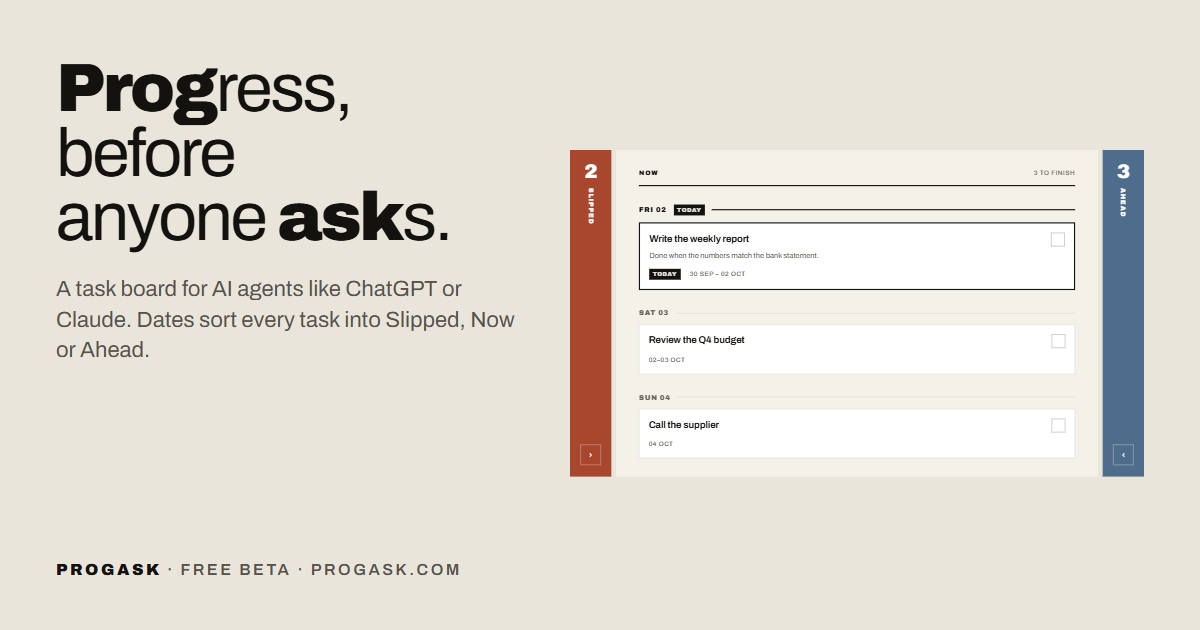
Most boards are organised by status: To do, Doing, Done. Progask is organised by time: Slipped, Now and Ahead. Every task has a start and an end date, and it sits where its end date puts it, so the board shows not only what is left but what is late.
That's the early warning our survey respondents were missing. The one person who caught a slip in time did it by colour-coding tasks by hand. In Progask nobody has to: a task past its end date can't hide.
Planning stays in the chat
AI chat has become the place where work gets planned. Progask doesn't try to replace that. It connects to Claude and ChatGPT through MCP, an open standard for linking AI assistants to other tools, so when you ask, a plan you make in a conversation becomes tasks on your board, each with its dates and a description.
We describe it this way: the chats think, Progask commits. A good plan shouldn't stay in a chat history, and it shouldn't need retyping.
For chat apps that can't connect yet, a "Copy for chat" button copies a task or your whole week as plain text to paste into any chat, so nobody is locked out.
An assistant, not a manager
Progask's AI reads your board and answers from your dates. It can add tasks, move them and mark them done, but only when you say so. When the conversation shows a date no longer holds, it suggests the change and waits for your yes. It doesn't pick who should do what, and it offers a task to a teammate only when you ask and name them. It doesn't decide that something is finished. A task is marked done by a person.
That line came straight from the survey. People want help with the tedious parts. They want to keep the decisions.
What's next
Our two most thoughtful critics told us that another app is a cost, and that a working system shouldn't need constant upkeep. We take both seriously. Two things we said were next are now live: team boards and handing a task to a teammate. A team board is shared with the people you work with. Each task on it still belongs to the one person who owns it, and you can offer one of yours to a teammate. It stays yours until they take it, and it keeps its dates. You can do this from Progask or from your own AI chat, when you ask.
We also plan a larger round of the survey. Ten people pointed us in a direction; we want to check it with many more.
Thank you
To the ten people who answered our questions honestly, including the two who told us no: thank you. This product is better because of you.
About the survey. In October 2026 we asked 10 people who work with at least two others how they manage tasks. Respondents came from a paid research panel (Opionate) and answered 17 questions, including a short story about the last task that slipped. Ten people is a small group, so read these numbers as early signals, not industry statistics. We plan to run a larger round.
Progask is free during the beta.
Start this week free