Part 3 of 8 · Thu 15 Oct 2026 · 3 min read
Your board says it's fine. Your deadline disagrees.
People rated their task boards 3.9 out of 5 for accuracy. Yet 7 of 8 found out about their last slipped task too late. Why an accurate board can still miss a slip.
We asked 10 people who work with others a simple question: on a typical day, how well does your task board reflect what's really happening?
They were fairly confident. On a scale of 1 to 5, the average was 3.9. Seven in ten gave their board a 4, one gave it a 5, and nobody went below 3.
Then we asked them to describe the last time a task slipped or got stuck, and how they found out. The stories told a different story.
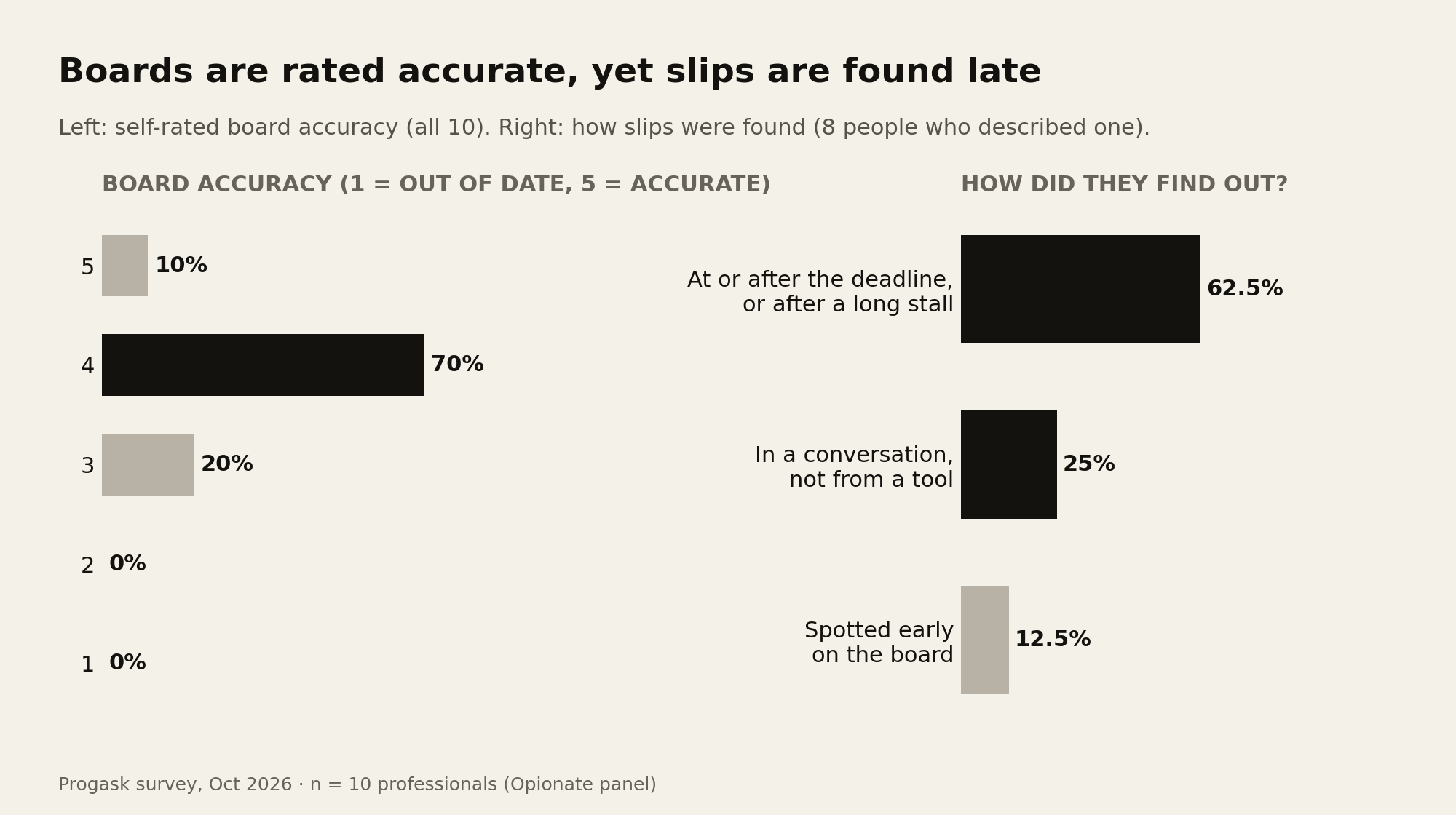
How slips were actually found
Eight people described how they discovered a slipped task. Seven of them found out too late or through another person:
- At or after the deadline. One person's spreadsheet wasn't updated, a deadline was missed, and they only found out once it had passed, by checking the spreadsheet. Another found out only when the work was due to be handed in.
- Because someone asked. One team lead learned a task was stuck only when someone on their team asked how it was going.
- Over coffee. One contributor, working on a project with another department, only found out near the end, from a chat on a break rather than from any tool.
Only one person caught a problem early from the board itself. They had colour-coded their tasks, so a task that stopped moving stood out: its status stayed the same while the other tasks moved on, which made it easy to notice.
Accurate isn't the same as early
How can both things be true: boards rated accurate, slips found late?
Because a board can be accurate about everything that has been recorded and still say nothing about what hasn't happened. A card that says "In progress" is correct right up until the deadline passes. The board isn't wrong. It just isn't paying attention to time.
That explains another detail in the data. Of the seven people who rated their board a 4, three still message the owner before they check the board when they need a status. They trust the board to be accurate. They don't trust it to be current.
What the one early catch got right
The one person who spotted a slip in time didn't have a smarter tool. They had a visual cue for stillness: tasks that stopped changing looked different from tasks that were moving.
That's the signal most boards don't show. The useful question isn't "what state is this card in?" but "is this card moving the way the plan said it would?" A task that should have progressed by now and hasn't is the earliest warning you'll get.
You can approximate this today:
- Put a date on "in progress". A task with no expected finish can't be late, so it can never warn you.
- Look for stillness, not status. Once a week, sort by "last updated" and ask about anything that hasn't moved.
- Treat a dependency as a risk. Two of the slip stories in our survey started with someone waiting on another team.
Why this shaped Progask
Progask is organised around time rather than status columns: Slipped, Now and Ahead. Every task has a start and an end date, and the board sorts by them. This week's work is grouped by the day it is due, so what has to land soon is in front of you. A task that misses its end date doesn't go on saying "in progress": it moves to Slipped, with the days counted, and stays there until someone gives it a new date. It isn't the colour-coding our one respondent built by hand, but it gives everyone the part that matters: a date on every task, and a late task that can't hide.
About the survey. In October 2026 we asked 10 people who work with at least two others how they manage tasks. Respondents came from a paid research panel (Opionate) and answered 17 questions, including a short story about the last task that slipped. Ten people is a small group, so read these numbers as early signals, not industry statistics. We plan to run a larger round.
Progask is free during the beta.
Start this week free