Part 2 of 8 · Mon 12 Oct 2026 · 3 min read
The status-chasing tax
70% of people in our survey named chasing others for updates a top frustration, and half ask a person before checking the board. Here's what that costs.
There's a question every team asks dozens of times a week. In Vietnamese we say "Việc này đến đâu rồi?" In English: "Where are we on this?"
It sounds harmless. In our survey of 10 people who work with others, it turned out to be the single most common frustration in their working day.
Chasing tops the list
We asked people to rank their biggest frustrations with managing tasks. "Chasing people for status updates" appeared in the top three for 70% of them, more than anything else.
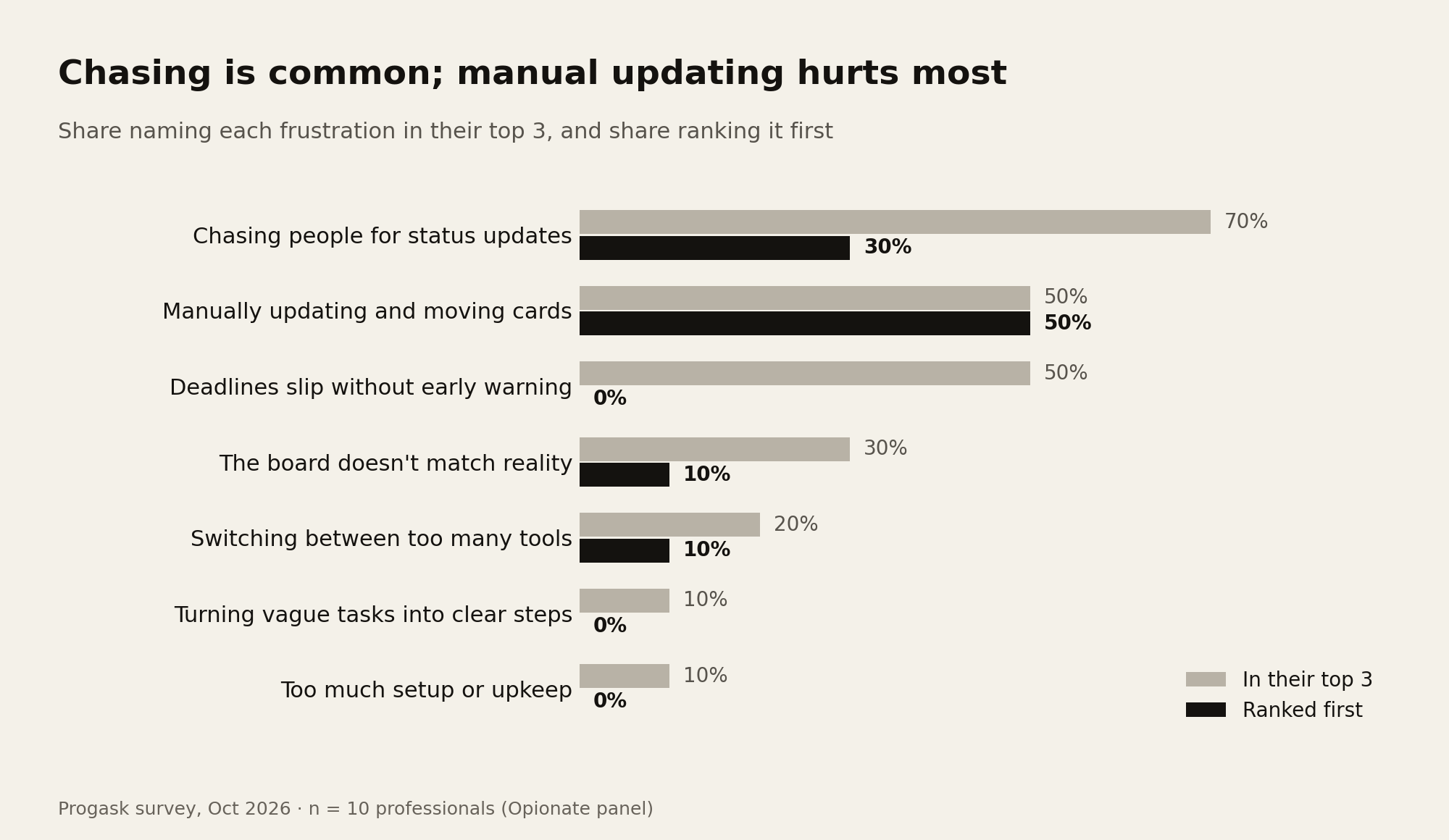
The runner-up is closely related. Half named "manually updating and moving cards", and every one of them ranked it first. Those two pains are two sides of the same coin: if people don't update the board, someone has to chase them; if they do, it's a chore that eats into the actual work.
Half skip the board entirely
When they need to know how far along a colleague's task is, respondents split down the middle. Half check the board. The other half go straight to the person: a message, a call.
Nobody chose to wait for the next stand-up or for the owner to report back. When people need a status, they need it now, and for half of them the fastest route is a human.
What chasing actually looks like
The stories people shared show how quickly a simple question turns into a time sink. One team lead described waiting on a bug fix from another team. It was well past its deadline. They chased the engineer assigned to it in the ticket and in private messages, got no reply, and in the end had to message the engineer's manager just to get an update.
One question became a ticket comment, several private messages and an escalation to someone's manager. Another team lead, working with a small team, said a busy week meant they stopped checking the dashboard, their colleague stopped updating it, and the task sat still for a long time until they talked to him directly.
The tax nobody budgets for
Chasing costs both sides. The person asking loses time and focus. The person being asked gets interrupted, often to report "still working on it". And the information they exchange lives in a chat thread, not on the board, so the next person to wonder has to ask all over again.
When we asked what people would change about how they manage tasks, one team lead's answer was simple: automate the status updates and follow-ups, so they spend less time chasing people for progress and can see at a glance which tasks are on track and which are falling behind.
A few things that help today
You don't need new software to reduce the tax:
- Ask about blockers, not progress. "Is anything stopping you?" surfaces the problem a status update hides.
- Agree on when updates happen. A fixed rhythm, such as end of day, beats ad-hoc pings at random times.
- Make "waiting on someone else" visible. Several stuck tasks in our survey were stuck because of another team. If the board showed that, nobody would need to ask.
Where Progask fits
We started Progask around that one question, "Where are we on this?", with the aim that the board answers it so people don't have to. In Progask every task has a start and an end date, and the board sorts itself by them. What is due this week sits in Now, grouped by the day it is due. Anything past its end date and still open waits in Slipped, with the days counted, until someone gives it a new date. Nobody has to move a card to keep it true.
About the survey. In October 2026 we asked 10 people who work with at least two others how they manage tasks. Respondents came from a paid research panel (Opionate) and answered 17 questions, including a short story about the last task that slipped. Ten people is a small group, so read these numbers as early signals, not industry statistics. We plan to run a larger round.
Progask is free during the beta.
Start this week free